
Welcome to the latest Quarterly Insight prepared by the FAS Investment Committee, designed to update you on their ongoing work and achievements, investment decisions reached this quarter and the actions taken to reposition the CDI portfolios to take advantage of expected market conditions.
Steady as she goes
The last quarter has continued the pattern that has defined market conditions over the year to date, where global equity markets have shown remarkable resilience in the face of fierce geopolitical headwinds.
Markets pulled back briefly when hostilities broke out in the Gulf, but have since marched northwards, with the S&P 500 posting fresh record highs at the time of writing. Granted, there have been periods of mild volatility, driven by the on-off nature of negotiations between the US and Iran, and wild price swings in semiconductor stocks; however, the mood amongst equity investors remains broadly positive, with attention firmly focused on recent corporate earnings from US tech giants. In the US, the second-quarter earnings season has seen many companies produce results that have surprised to the upside, with few notable misses.
Beneath the optimism, risks are building. Government bond yields continue to climb, with longer-dated issues selling off as investors weigh up how the Federal Reserve will respond to inflation risk. The build-out of artificial intelligence infrastructure has driven major global technology firms such as Alphabet and Meta to borrow heavily, and this combined with concerns over central bank policy, is leading to nervousness in bond markets.
Political risk is likely to increase over the coming quarter as the US mid-term elections approach in November. A sitting President’s party rarely gain seats in the House and Senate at the midpoint of an election cycle, and a loss of power could constrain President Trump’s policy agenda for the remainder of his term. Beyond Washington, investors will continue to monitor events in the Gulf closely, given their direct bearing on oil and gas prices, and on inflation more broadly. There is plenty to justify a more measured view of the outlook for markets over the months ahead; however, at present, it is a case of “steady as she goes”.
CDI Quarterly Rebalance
The CDI range of portfolios have continued to perform well on an absolute and relative basis, extending the lead over benchmarks during the last quarter. The chart below shows the year-to-date performance of the CDI Progressive Growth and Progressive Income portfolios (in dark and light blue) compared to the representative IA Mixed Investment 40-85% Shares sector (represented by the blue hashed bar) and the CDI Balanced Growth and Balanced Income portfolios (in red and orange) compared to the IA Mixed Investment Sector 20-60% Shares sector (represented by the red hashed bar).
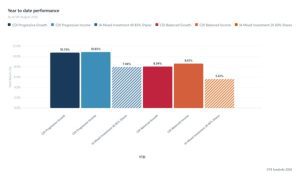
The FAS Investment Committee agreed to make modest changes to the portfolios in the August rebalance. Whilst remaining content to continue to hold the higher cash weightings that have been present within the CDI portfolios over recent months, the Committee chose to slightly reduce the allocation to cash within the Progressive Growth and Progressive Income portfolios, to more closely align levels of risk of these two mandates compared to the medium-risk Balanced Growth and Balanced Income. In Progressive Growth, the Committee added to the Invesco UK Enhanced Index and L&G Global 100 funds, and increased weight in the Vanguard Global Equity Income fund within Progressive Income.
The key fund changes at this review have been the reduced allocation to Schroder Sterling Corporate Bond on performance grounds, and the Committee’s view that the fixed-income exposure should remain firmly within short-duration bonds. The Committee has increased the weight held in Royal London Diversified Asset Backed Credit in several model portfolios. Managed by members of the experienced team at Royal London, this fund holds a diversified mix of short-duration corporate bonds, floating rate notes and other debt instruments. Performance has been consistently strong, alongside the very low levels of volatility displayed over the medium term.
The other notable changes were within the two Future portfolios, where Liontrust Sustainable Future Monthly Income Bond was replaced by Royal London Sustainable Short Duration Corporate Bond. The new fund closely meets the Committee’s preference for short-dated bonds, and Royal London’s internal screening process aligns the fund closely with the aims and objectives of the Future portfolios.
The next scheduled portfolio rebalance will be in November 2026, although the Investment Committee will continue to monitor economic and geopolitical factors on an ongoing basis, and review fund performance. The Committee can arrange an ad hoc portfolio adjustment at short notice if this is agreed to be an appropriate course of action.
Positive outlook for active management
The CDI portfolios are built from the FAS Investment Committee process, which has long championed the prospects for actively managed funds. Whilst passive funds, which simply track a particular index, have a place in portfolio construction, quality active management can add significant value and additional portfolio returns. This is why the CDI portfolios offer a blended approach, holding allocations to index funds, where appropriate, but also ensuring that a good proportion of each portfolio is managed on an active basis.
We continue to see greater use of passive-only strategies amongst our peers. Many argue that markets are so efficient that active management can make little difference to overall performance, whilst adding unnecessary costs. This is not a view we support. The additional returns generated by the actively managed funds we hold, known as alpha, underpins our portfolio performance. We also challenge the notion that active fund management is expensive; many of the active funds we hold carry competitive charging structures, and we can often access lower priced share classes for our clients.
With global indices standing close to or at all-time highs, and markets complacent about growing risks, the case for a passive-only approach to investment looks increasingly shaky. The coming months may well see active managers with strong track records seek out opportunities that add further value.
Summary
We hope you have found our latest Quarterly Insight of interest. Please do get in touch if you wish to discuss any aspect of the work of the FAS Investment Committee or would like more information on the performance or features of the CDI discretionary managed portfolio range.
Source: FE Analytics August 2026